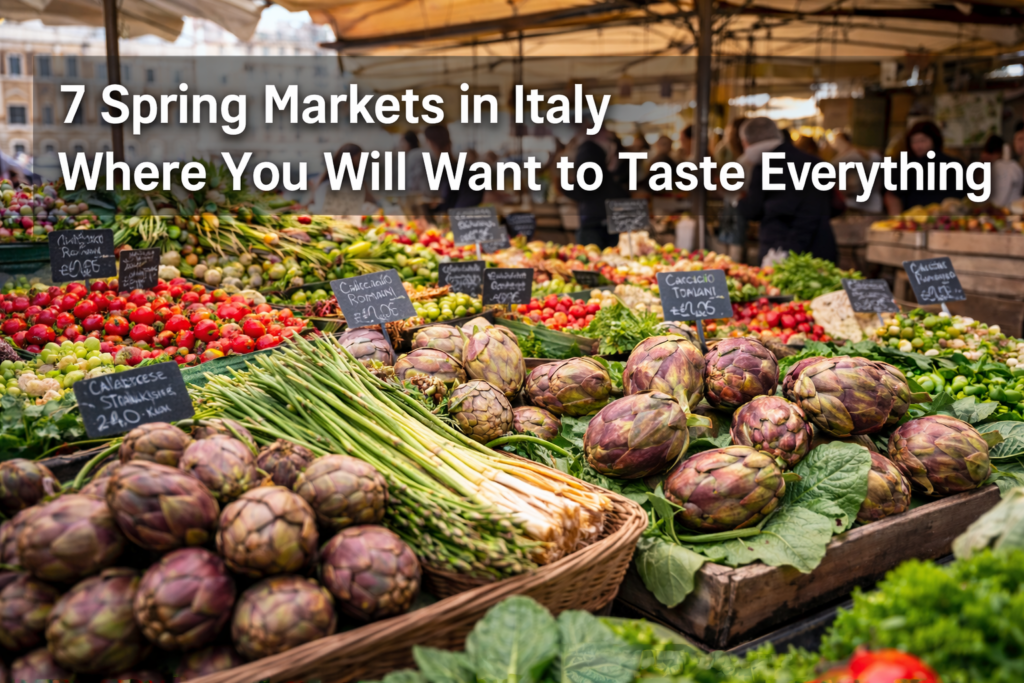
7 Spring Markets in Italy Where You’ll Want to Taste Everything

Spring in Italy means one thing: amazing food at the markets.
The weather warms up. The vegetables get brighter. And the market stalls fill with things you only see this time of year.
Forget museums for a morning. Go where Italians go. Talk to the vendors. Try something new. Eat with your hands.
Here are 7 Italian markets that are at their absolute best in spring. Bring cash. Come hungry.
1. Mercato di Rialto (Venice)

Why go in spring: This is when Venice’s lagoon wakes up. The market sits right on the Grand Canal. Boats still deliver the catch of the day, just like they have for 1,000 years.
What to try in spring:
-
Castraure: The first baby artichokes of the season from Sant’Erasmo island. They are tiny, tender, and you can eat the whole thing. The season lasts only three weeks.
-
Schie: Tiny gray lagoon shrimp. Eat them fried (fritte) or boiled with polenta (polenta e schie). You eat the whole shrimp—shell, head, everything.
-
White asparagus from Bassano: Delicate, slightly bitter, and in season for a short time. Venetians eat them boiled with eggs and olive oil. Simple. Perfect.
Where: Next to the Rialto Bridge
When: Tuesday to Saturday, 7:30 AM – 1:00 PM (go early—by 11 AM, vendors start packing up)
Local tip: Look for stalls that say “Sant’Erasmo” or “Bassano.” That means it’s the real local stuff.
2. Mercato di Sant’Ambrogio (Florence)

Why go in spring: Tourists crowd the big Mercato Centrale. Locals shop here. It is smaller, calmer, and more real. The market dates back to 1873.
What to try in spring:
-
Baccelli e pecorino: Raw fava beans with fresh sheep cheese. This is the taste of Tuscan spring. Pop the beans out of the pod, put a slice of cheese on top, eat.
-
Carciofi morellini: A local artichoke variety. Eat them raw in salads or fried.
-
Frittelle di San Giuseppe: Sweet rice fritters. They are tied to March 19th (Father’s Day), but you might still find them in early spring.
-
Wild asparagus: Foraged from the countryside, not farmed. Look for them in the outdoor stalls.
Where: Piazza Lorenzo Ghiberti, Florence (east of the Duomo)
When: Monday to Saturday, 7:00 AM – 2:00 PM
Local tip: Stop for lunch at the market’s food counter. Try lampredotto—Florence’s famous tripe sandwich. It’s a local ritual.
3. Campo de’ Fiori (Rome)

Why go in spring: It is Rome’s most famous market, and for good reason. By day, it is all about food. By night, it turns into a bar scene. Go in the morning before the crowds.
What to try in spring:
-
Carciofi alla romana: Artichokes braised with garlic and mint. Soft, rich, delicious.
-
Fresh fava beans: Romans eat them raw with pecorino cheese, just like in Tuscany.
-
Wild asparagus: Thinner and more intense than the farmed kind. Perfect in frittatas.
-
Strawberries: Small, sweet, and deeply red. Spring is when they actually taste like something.
Where: Piazza Campo de’ Fiori, Rome
When: Monday to Saturday, 7:00 AM – 2:00 PM
Local tip: Get there before 8:00 AM. Watch the vendors set up. The produce is freshest right when they open.
4. Mercato di Ballarò (Palermo, Sicily)

Why go in spring: This is not a polite market. It is loud, chaotic, and absolutely alive. Ballarò is Palermo’s oldest market, with Arab roots going back centuries. Spring brings the best produce.
What to try in spring:
-
Arancini: Fried rice balls with fillings like meat or butter. Perfect street food.
-
Panelle: Chickpea fritters. Eat them in a sandwich or on their own.
-
Fresh fava beans: Sicilians eat them raw with salt and bread.
-
Spring artichokes: Often fried or stuffed.
-
Wild greens: Foraged from the countryside around Palermo.
Where: Ballarò neighborhood, Palermo (near the train station)
When: Daily, roughly 7:30 AM – 8:00 PM
Local tip: Go with an empty stomach. Walk from stall to stall and eat as you go. That is how locals do it.
5. Mercato Trionfale (Rome)

Why go in spring: It is one of Rome’s biggest indoor markets. Near the Vatican, but locals fill the aisles. This is where Romans buy their vegetables, cheese, meat, and bread.
What to try in spring:
-
Puntarelle: A bitter chicory that peaks in late winter and lingers into early spring. Romans dress it with anchovy-garlic sauce. Crunchy. Addictive.
-
Artichokes: All kinds. Look for the round romanesco variety.
-
Agretti: Also called “friar’s beard.” A spring green that looks like grass but tastes mild and lemony. Best blanched with olive oil and lemon.
-
Fresh ricotta: Spring milk is richer. The ricotta is creamier.
Where: Via Andrea Doria, Rome (Prati neighborhood)
When: Monday to Saturday, 7:00 AM – 2:00 PM
Local tip: Take a break at one of the market’s small bars. Stand at the counter, order an espresso, watch the shoppers go by.
6. Mercato Centrale (Florence)

Why go in spring: The ground floor is the old market—meat, cheese, vegetables, chaos. The upstairs is a modern food hall with great casual restaurants. Both are worth your time.
What to try in spring:
-
Fresh pasta with nettle pesto: Wild nettles grow in spring. The pesto is bright green and tastes like the countryside.
-
Fava beans and pecorino: Yes, again. It is everywhere in spring for a reason.
-
Porcini mushrooms: Spring brings the first porcini of the year. Not as famous as autumn porcini, but still wonderful.
-
Tuscan wines: The market has several wine bars. Try a glass of Chianti with your lunch.
Where: Piazza del Mercato Centrale, Florence (San Lorenzo district)
When: Daily, 8:00 AM – Midnight (ground floor closes earlier, upstairs stays open)
Local tip: Go to the truffle vendor if you visit in late spring. Fresh truffles start appearing in May.
7. Mercato di Mezzo (Bologna)

Why go in spring: Bologna is Italy’s food capital. The Quadrilatero—the old market quarter—is a maze of narrow streets packed with food shops. Spring brings the best ingredients to this historic spot.
What to try in spring:
-
Tortellini: Fresh pasta stuffed with meat. Buy it from a pasta shop and cook it that night.
-
Parmigiano-Reggiano: Spring milk makes excellent cheese. Taste before you buy.
-
Mortadella: The original Bologna sausage. So much better than what you get at home.
-
Asparagus: From the countryside around Bologna. Often served with eggs and Parmigiano.
-
Torta di riso: A spring cake made with rice, almonds, and candied fruit. Local and traditional.
Where: Quadrilatero district, Bologna (behind Piazza Maggiore)
When: Many shops open Tuesday to Saturday, mornings and early afternoons
Local tip: Don’t just buy food—eat there. Several small places serve plates of pasta and glasses of wine right in the market streets.
Why Spring Markets Are Special
Italian markets change with the seasons. In spring, the shift is dramatic.
The winter vegetables—cabbages, pumpkins, kale—disappear. In their place: artichokes, fava beans, peas, asparagus, wild greens, strawberries.
Vendors get excited. Customers get excited. Everyone talks about the first castraure, the first white asparagus, the first fava beans of the year.
This is not marketing. This is how Italians have always eaten. When something appears at the market, it goes on the menu. When it disappears, you wait until next year.
That is what makes spring special. The waiting is over. The good stuff is back.
Tips for Visiting Italian Markets in Spring
| Tip | Why |
|---|---|
| Go early | The best stuff sells first. Go between 8 and 10 AM. |
| Bring cash | Many small vendors don’t take cards. |
| Talk to vendors | Ask what’s good today. They know. They will tell you. |
| Try something new | See a vegetable you don’t recognize? Buy it. Ask how to cook it. |
| Eat on the spot | Many markets have food counters or street food. Don’t wait. Eat now. |
| Bring a bag | You will buy more than you expect. |
Final Thoughts
Markets are the heartbeat of Italian food culture.
In spring, that heartbeat gets faster. The stalls explode with color. The air smells like artichokes and wild greens. Locals crowd the aisles, happy that winter is finally over.
Skip one museum. Go to a market instead.
Walk slowly. Look at everything. Point at things you don’t recognize. Ask questions. Taste whatever someone hands you.
That is how you really experience Italy.
Buona primavera e buon appetito! 🍽️🌿